Jim
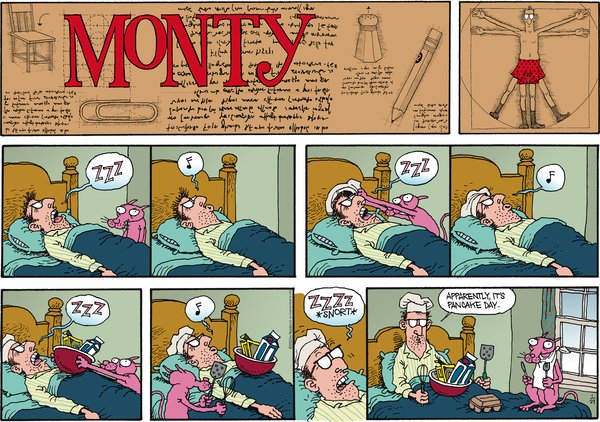
Meddick's Monty, Jan 29, 2012
SHROVE TUESDAY
|
Thanks to Cast
in
Style UK (purveyors of indispensible cast-iron
skillets and other cast-iron wares) for letting me know
that Shrove
Tuesday (known outside Britain and Ireland as Fat
Tuesday or Mardi Gras) is also known as Pancake Day -- a
chance to use up all the eggs and other goodies in the
house before Lent!
|
Here -- by popular demand -- is the recipe
I use for pancakes. People have always liked my pancakes,
but the reviews since I switched to this recipe have been raving
enthusiasm. I make pancakes on many Saturday mornings for my
wife Pam,
our beautiful daughter Paloma, and anybody else who might be in
the vicinity. I even take them on the road sometimes, packing up
the wet and dry ingredients before setting off to a friend's
Vermont cabin or a breakfast meeting here in town.
Paloma used to insist on Mickey Mouse
pancakes - one medium circle with two small circles for the
ears. All dads should
master this technique - a large turner is helpful.
This is
not much harder than using Jiffy, and the results are so much
better that you will never turn back!
This recipe
actually represents an important turning point in my life -- the
deepening of my slow food journey.
In 1997, my sister-in-law was visiting us in our new home. I had
planned to make pancakes, but was out of Jiffy. When I
mentioned this, my beloved sister-in-law actually laughed at me.
She knew we liked to cook, and could not believe we would need
packaged mix to make pancakes. She said, "There must be a
pancake recipe in this house." She was correct, and we had all
the ingredients for the basic recipe. Over the years, we have
ensured that we almost always have ingredients on hand to make a
healthy meal, and in fact we usually plan our week's meals each
Sunday, to avoid resorting to "box food."
What you need:
(This feeds 3-4 adults; you may
need to double or triple for a bigger crowd. See
variations below for a healthier and more
earth-friendly ingredient list.)
|
EQUIPMENT
Measuring cups
Measuring spoons
Large bowl
Medium bowl
Whisk (maybe two)
Wooden spoon
Rubber spatula (scraper)
Your indispensible, well-seasoned, cast-iron
griddle
or skillet (other pans will do, but I cannot guarantee
the results)
Gas stove preferred; electric stove if that is all that is
available; I'm sure a camp fire would work, too.
|
DRY
1-1/2 cups all-purpose flour
1 tablespoon granulated sugar
1/4 teaspoon salt
1 teaspoon baking soda
2 teaspoons baking powder
1/4 teaspoon nutmeg
|
WET
2 eggs
3 tablespoons melted butter (or light oil, such as Canola)
1-1/2 cups buttermilk*
1 teaspoon vanilla (vanilla extract if you are in a pinch)
Plus, butter for cooking
|
* If buttermilk is not available, stir 1-1/2
teaspoon vinegar into 1-1/2 cups milk, and let stand for 10
minutes while you prepare the other ingredients OR put a large
dollop of yogurt in a measuring cup and then fill to 1-1/2 cup
line.
Preheat oven to about 200 degrees. A bit hotter is
OK. Put a platter (or all the serving plates) into the oven. Also,
start warming the syrup, either in the oven or on the stovetop.
In a large bowl, measure dry ingredients carefully, and
whisk together. (To measure flour, fluff it, spoon it into
measuring cups, and scrape off excess.)
In a small bowl, beat eggs, then blend in the other wet
ingredients.
Using a spoon and spatula
(rubber scraper), stir wet ingredients into the larger
bowl of dry ingredients, mixing enough to combine, but not to
remove all lumps.
Optional enhancement: Gently fold in 1/2 cup to 1 cup
berries or chopped apples.
Heat the skillet or griddle, then add butter (perhaps with a
little canola oil) and melt it. The griddle is hot enough when
drops of water will dance on it, but it is too hot if the butter
or oil start to smoke. I usually find it necessary to reduce the
flame after each round of pancakes, to maintain the optimal
temperature.
Use a ladle or large spoon to drop 1/4 to 1/3 cup of batter on to
hot griddle. When bubbles cover the top of the pancakes, turn
gently. Remove when set, just about 30 seconds. Place pancakes
into oven as they are completed.
Serve with real butter and warm pure maple syrup. If you use
berries, consider whipping some heavy cream (whisk just a bit of
sugar and vanilla into cream in a chilled bowl until stiff) as a
topping.
Variations
The original recipe describe above is a bit decadent. Any or all of
the following substitutions can be made to improve the nutritional
balance of the pancakes, by reducing the simple carbs and fat while
increasing the complex carbs and protein. The results are just as
flavorful, probably more so. All substitutions are based on a single
recipe. If you are doubling or tripling the recipe, don't forget to
double or triple all of
the ingredients.
- Sugar: In place of
sugar, I use an equal amount of honey or agave nectar. By the
way, in most baking recipes, you can make a similar substitution
or reduce the sugar by half without harming flavor. Sometimes
flavor is actually enhanced this way.
- Oil: You can
substitute canola oil or another light vegetable oil for the
butter (both on the griddle and in the wet mix). As much as I
love olive oil, I do not recommend it for this recipe. See notes
for flax seed and applesauce below.
- Flour: I often use whole-wheat flour for 1/2 cup of the
1-1/2 cups required. Any more would result in a heavier pancake,
and probably would require adjusting some of the other
ingredients.
- Oats: I sometimes add 1/4 cup of rolled oats, or a
packet of instant oats.
- Flax seed: You can add
a two tablespoons of flax seed, in place of the butter. This
greatly increases the fiber and enhances the texture.
- Applesauce: I often replace the melted butter in the
pancakes with 1/4 cup of pure (no added sugar) applesauce. This
is a baking trick I learned long ago, and it can be applied to
many cake recipes.
- Yogurt: I usually place about 3/4 cup fat-free, organic
yogurt in the measuring cup, and fill the rest of the way (to
1-1/2 cups) with low-fat or fat-free, organic milk. I think this
actually improves the texture of the pancakes.
- Eggs: I used to replace one of the eggs with "fake"
eggs, to lower the fat and cholesterol content, but I've decided
that a few really good local, cage-free, organic eggs each week
are better than a lot of processed fake eggs. For some people,
however, medical conditions will warrant the substitution.
Buying local: As fossil
fuels become more expensive and climate change becomes a greater
concern, it is important to support local and regional agriculture,
to help develop sources for food closer to home. In New England,
this can include King Arthur flour, Stonyfield yogurt, Garelick
milk, honey from a local farm stand, and Cabot butter. It can also
include any number of pure maple syrups or fruit preserves for
toppings. These toppings are healthier than mass-market "syrups" and
jellies that rely for their sweetness on high-fructose corn syrup,
which is provided by oil-dependent agribusiness and which
contributes to diabetes and other health problems.
Beverages
A tall glass of milk goes well with pancakes. Of course, coffee is almost essential. I highly
recommend any fair-trade, organic Central American arabica coffee (especially
Nicaraguan), roasted to Full City (instead of a very dark roast such
as French) to get the smooth, rich flavors that go well with
pancakes.
Learn more
Feel free to browse the rest of my environmental
geography pages, especially the I-Can-Do page. You may also be
interested in my chicken crepe recipe,
though at the moment (March 2007) it does not really address the
healthy alternatives, or my general page on food.